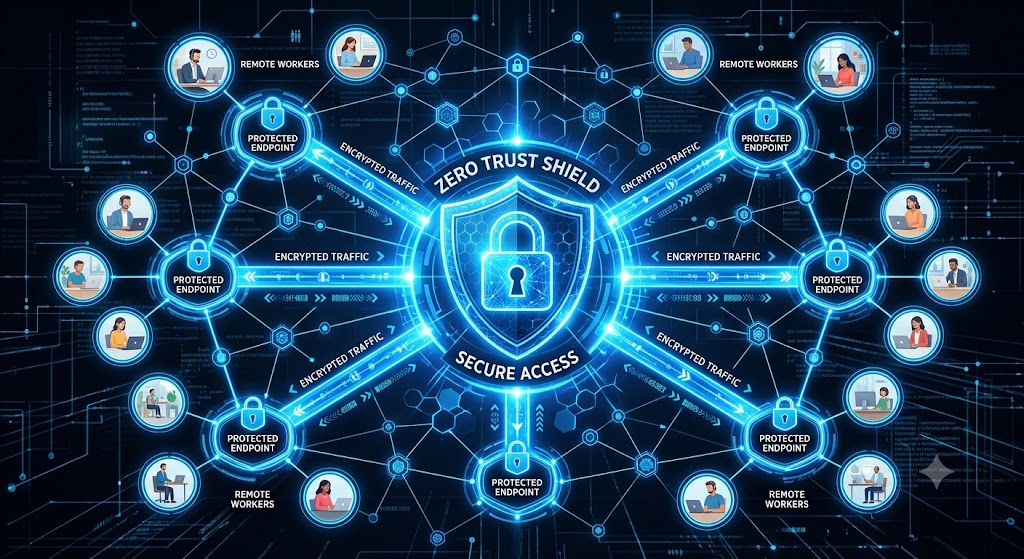
The Perimeter Is Gone
Distributed teams dissolved the traditional security perimeter. Employees connect from home networks, personal devices, and coffee shops, accessing cloud resources that never sit behind a corporate firewall.
Security models built on the assumption of a trusted internal network simply do not apply anymore. The new perimeter is identity, and every access request must be treated as if it originates from a hostile network.
Zero Trust in Practice
Zero trust replaces "trust but verify" with "never trust, always verify." Every user and device is continuously authenticated and authorized, with access granted on a least-privilege basis scoped to the specific resource needed.
In practice this means strong identity management, device posture checks, and micro-segmentation so that a single compromised account cannot move laterally across the entire environment.
Securing Identity and Endpoints
Phishing-resistant multi-factor authentication is the single highest-impact control for distributed teams, neutralizing the credential theft that drives most breaches. Hardware keys and passkeys raise the bar further.
Endpoint protection, automatic patching, and encrypted drives ensure that the laptops scattered across employees’ homes do not become the soft underbelly of the organization.
People Are the Last Line
Technology alone cannot secure a remote workforce. Regular, realistic security awareness training—especially around phishing and social engineering—turns employees from the weakest link into an active line of defense.
Pair this with a blameless, well-rehearsed incident response plan so that when something does go wrong, people report it quickly instead of hiding it.